Freedom versus security
The KillerFreedom versus security takes concrete form in Dany’s departure from the Civil Service: the organization offers a measure of protection, but she no longer believes that life within it can improve. When she leaves and becomes a victim of the Killer, the promised liberty is shadowed by danger. The reversal makes security neither an uncomplicated good nor freedom an uncomplicated release; each is bound to a cost, and the institution’s protection depends on remaining under its authority.
Protection as an Institutional Bargain
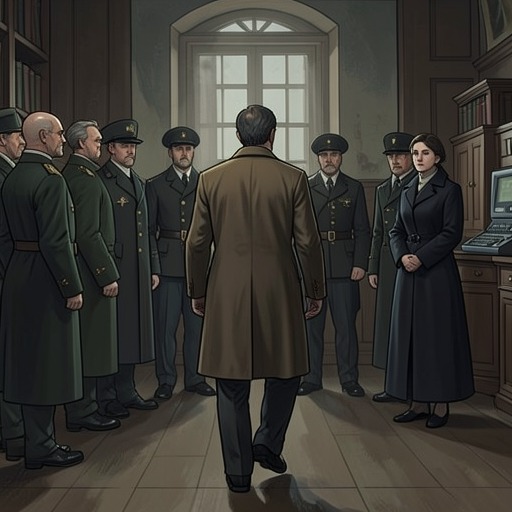
The conflict first appears in the Architect’s workplace reprimand. As Dany’s superior, he warns her that the Civil Service dislikes lateness and impulsiveness, placing her choice within an institution that regulates conduct as well as providing a place of employment. The exchange is personal, but its terms are organizational: belonging brings shelter, while departure means giving that shelter up.
Dany initially describes her need in the language of rest. She has made up her mind to leave, says she is tired, and insists that a short holiday will not be enough. When the Architect offers to apply to the Departmental Board for a week of leave at half pay, she answers that she needs a permanent rest. His recognition of what she means shifts the exchange from a routine discussion of leave to a decision about severing her connection with the service. The limited accommodation he can propose does not answer her underlying dissatisfaction.
Dany’s Choice to Leave
Dany explains that she had hoped things might change, but they have remained the same and she sees no prospect of improvement. Her departure is therefore not simply an impulsive rejection of a warning: it follows disappointment with the possibility of change inside the organization. Yet the scene leaves the nature of that hoped-for improvement unspecified. What is clear is the pressure between a known, protected arrangement and an uncertain life outside it.
The Architect makes the bargain explicit. If Dany no longer belongs to the Civil Service, he says, the organization can no longer take her under its wing; he warns her of the dangers and then refuses responsibility for what may follow. Dany confirms that she understands and tells him he need not repeat himself. The warning establishes that her decision is informed, while his withdrawal of responsibility draws a boundary around the protection he claims the institution provides: it applies to a member of the service, not to someone who has chosen to leave.
The Cost Revealed Afterward
The later revelation gives the earlier warning its terrible force. When the blonde girl is identified as Dany, the Architect confirms that she was his secretary and is now his former secretary. He says she had been safe in the Civil Service because the Killer does not attack the service. Her departure has thus removed her from a specific protection—not merely from a workplace or a familiar routine.
The Architect calls her choice a desire for liberty and presents her fate as the consequence of leaving the protected organization. His explanation is pointed, but it remains his account of the event, not a general proof that freedom itself caused her death. He says he had expected the danger, and adds that she might have avoided it if she had gone well outside the district after leaving. He then blames victims for returning to the scene of a crime. The scene supplies these claims as part of his response; it does not establish every detail of Dany’s movements or make his judgment neutral.
Contrasting Responses
Bérenger responds to the revelation with horror and grief. Earlier, he had mistaken Dany’s words to the Architect for an answer to his own advances, even though the Architect corrected him: she was speaking to her superior, not to him. After her fate is disclosed, Bérenger laments that she did not have time to say yes to him. His personal disappointment is painfully out of step with the scale of her loss, and it underlines how little control either the flirtation or the workplace conversation gave him over what happened.
The contrast sharpens the concept’s dramatic structure. Dany’s insistence that she understands the danger prevents her choice from being treated as simple ignorance; the later outcome nevertheless shows how narrow the available alternatives are. The Civil Service offers safety on institutional terms, while departure offers the possibility of change without that guarantee. The Architect turns this trade-off into an admonition after the fact, and Bérenger’s lament cannot undo it. Freedom remains a choice, but the play makes visible the lethal inequality between the risks borne outside the institution and the protection it withholds once membership ends.